
Six months after our divorce, my ex-husband called to invite me to his wedding.
I was in a hospital bed in Brooklyn with my newborn daughter asleep against my chest.
Rain tapped the window in soft, restless bursts.
The room smelled like antiseptic, tired flowers, and the paper coffee my mother had left on the rolling tray before she went downstairs to move her SUV.
My body hurt in places I did not know could hurt.
My hair was damp at my temples.
My daughter was warm, impossibly small, and breathing against me like she had always known exactly where she belonged.
Then Adrian Carter’s name lit up my phone.
For one second, I only stared.
I had not heard his voice in weeks except through lawyers, forwarded messages, and the kind of clipped voicemail that men leave when they want a record showing they were polite.
Six months after the divorce, Adrian was not calling to apologize.
He was not calling to ask if I was okay.
He was not calling because he had grown a conscience in time for fatherhood.
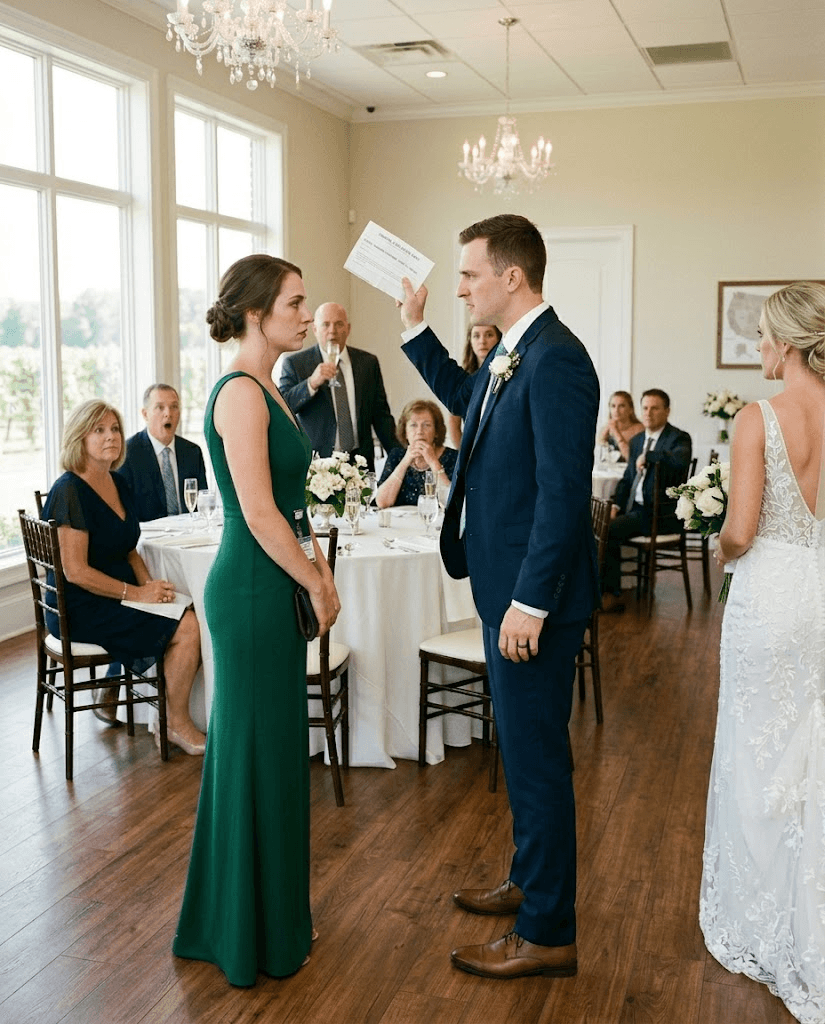
He was calling from a wedding.
His wedding.
I almost let it go to voicemail, but the monitor beside me beeped once, steady and small, and my daughter’s fingers curled into the front of my gown as if she were anchoring me to the bed.
I answered.
“Emma,” Adrian said.
His voice was bright and polished, the same voice he used at company events, charity dinners, and any room where someone important might be listening.
“I wanted you to hear it from me first,” he continued. “Today, I’m marrying Vanessa.”
Behind him, I heard violins.
I heard laughter.
I heard the clink of glass and the easy hum of people who thought they had shown up for a love story.
They had no idea they were standing near the final room of a lie.
Vanessa had been my assistant for two years.
She knew how I took my coffee.
She knew which meetings drained me, which files I kept locked, which emails I flagged twice because my gut told me something was wrong.
She had once brought me soup when I stayed late with a fever.
She had once sat beside me in an office break room and told me I deserved a husband who came home before midnight.
By then, she had already been meeting mine in hotel rooms.
Chicago.
Miami.
Los Angeles.
Business trips that came with delayed flights, dead phone batteries, and receipts Adrian said I was too paranoid to question.
There are betrayals that arrive like thunder.
Then there are betrayals that sit beside you for two years, smile with lip gloss on, and remember how much cream you take in your coffee.
“Congratulations,” I said.
The word came out flat.
Adrian laughed softly.
“Still cold,” he said. “That’s why we didn’t work.”
I looked down at my daughter.
She made a tiny sound, then settled again with her cheek pressed to my chest.
“What do you want?” I asked.
“To invite you,” Adrian said. “Vanessa thinks closure would be healthy. No hard feelings.”
No hard feelings.
He said it the way people say weather might clear.
Not after the family court hallway where he called me unstable.
Not after the county clerk stamped a divorce decree I could barely see through tears.
Not after the Carter Holdings papers vanished from my side of the table because Adrian always knew which details to bury and which ones to shove under my face.
Not after he made infertility sound like a moral failure.
Not after he told people Vanessa had given him hope for the family I never could.
Men like Adrian do not fear pain.
They fear paperwork.
Pain can be denied.
Paper leaves a timestamp.
At 2:17 p.m., while he stood outside a Manhattan church in a groom’s suit, Adrian Carter called the woman he had divorced and invited her to watch him marry the assistant he had slept with.
That was the first timestamp.
I did not know yet how much it would matter.
“I just gave birth,” I said.
The music behind him seemed to grow louder for a second because he went completely silent.
Then his voice changed.
“What did you say?”
“I said I gave birth.”
“Whose baby is it?”
The question hung in the hospital room like something ugly had been set down on the clean sheets.
I closed my eyes.
Not because I was afraid.
Because I was tired.
I was tired of men who lied loudly and then demanded proof from women who survived quietly.
“Go back to your bride,” I said.
“Emma,” he whispered, and all the polish slipped.
“Tell me that child isn’t mine.”
I looked toward the bassinet, where the small folded hospital blanket waited with my daughter’s extra cap.
The discharge folder sat on the tray beside it.
Inside were the hospital intake papers, the birth certificate worksheet, and the copy of the family court notice my attorney had told me to keep close.
“You signed every document without reading it,” I said. “You always hated details.”
He hung up.
For twenty-eight minutes, nothing happened.
A nurse came in at 2:31 p.m. to check my blood pressure.
She adjusted the cuff, smiled at my daughter, and asked if I needed more ice water.
I said no.
My mother texted at 2:38 p.m. that the parking garage was a disaster and she would be back up as soon as she could.
Somewhere down the hallway, another baby cried.
Somewhere closer, a cart rattled over a seam in the floor.
I kept my phone facedown on the blanket beside me.
I did not call Adrian back.
I did not text him.
I did not tell Vanessa.
For one ugly heartbeat, I wanted to.
I wanted to send a single photograph.
I wanted to ruin the church steps the way he had ruined my home.
I wanted him to feel, publicly and instantly, what it felt like to be made small in front of people who thought they knew the story.
Instead, I put one hand over my daughter’s back and counted her breaths.
Survival is not always a speech.
Sometimes survival is not answering the second call.
The truth had not been a secret because I was ashamed of it.
The truth had been documented, delivered, and ignored.
When I learned I was pregnant, the divorce had already turned mean.
Adrian had filed first.
He wanted speed, privacy, and control.
He wanted the apartment handled quietly.
He wanted Carter Holdings untouched.
He wanted me out of the marital narrative before Vanessa stepped into it wearing the expression of a woman who had been promised a cleaner life.
My attorney told me to disclose the pregnancy in writing.
So I did.
There was a medical confirmation letter.
There was a notice sent through counsel.
There was a family court filing that mentioned the pregnancy in plain black type.
There was a certified copy.
There was Adrian’s signature on the acknowledgment.
He signed because he thought he knew what the papers said.
He signed because reading details made him impatient.
He signed because men like Adrian assume paperwork exists for other people.
During the marriage, that arrogance had looked powerful.
During the divorce, it looked efficient.
In the hospital room, with a daughter he had never bothered to notice waiting in my arms, it finally looked stupid.
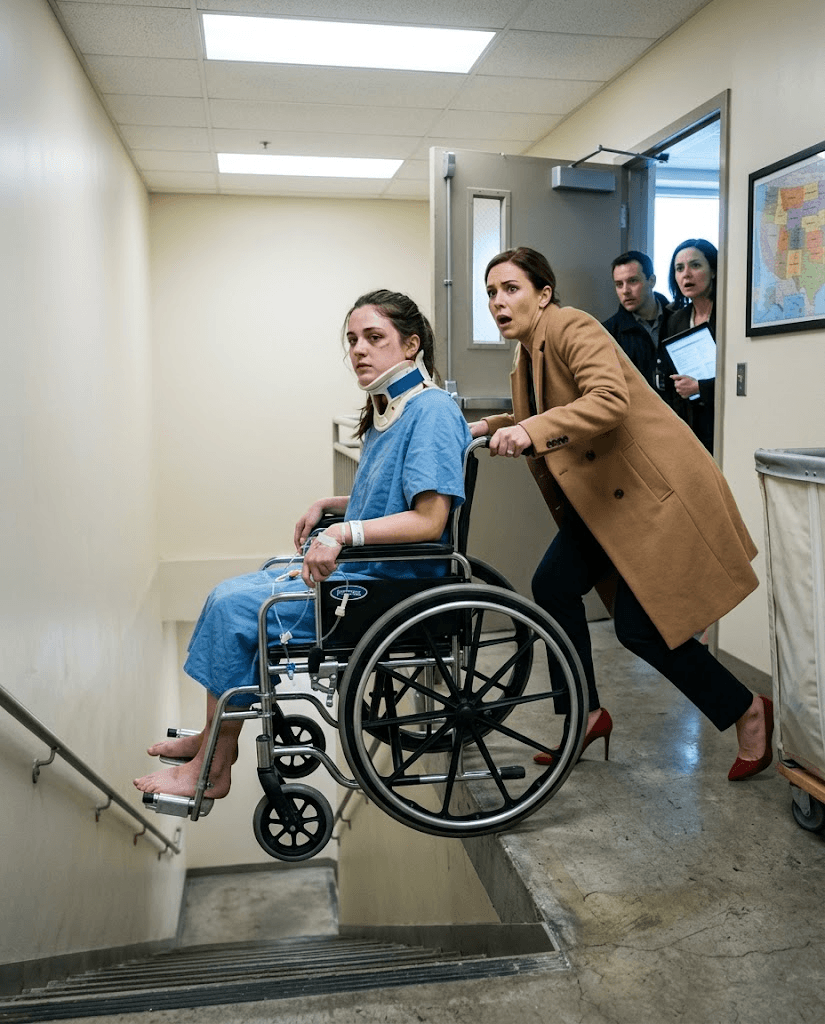
At 2:45 p.m., the hallway erupted.
Fast shoes.
A woman’s breathless voice.
A nurse saying, “Sir, you can’t just—”
The door flew open so hard it hit the wall.
Adrian rushed in wearing his groom’s suit.
His bow tie was undone.
Rain had darkened one shoulder of his jacket.
His face had lost every bit of color.
Behind him stood Vanessa in her wedding dress, her veil crooked and her diamonds trembling at her throat.
For a second, nobody moved.
The monitor kept beeping.
The rain kept running down the glass.
The little American flag pin on the hospital bulletin board near the doorway trembled from the force of the door.
Adrian looked at me first.
Then he looked at my daughter.
Then his eyes dropped to the tiny hospital band around her ankle.
Carter.
The name was printed in black ink, small and official and impossible to flatter.
His mouth opened.
Nothing came out.
Vanessa stepped farther into the room.
“Adrian?” she whispered.
He did not look at her.
He stared at the baby like she was a contract he had signed without reading and now wanted someone else to void.
The nurse moved closer to my bed.
“Ma’am,” she said, careful and firm, “do you want them removed?”
I looked at Adrian’s hands.
They were shaking.
Not with love.
Not with guilt.
With calculation.
That was the part Vanessa saw.
The church could have forgiven shock.
A bride in a doorway might have forgiven panic.
But calculation has a particular face.
It looks sideways.
It looks for exits.
It looks for the version of the truth that can still be sold.
“Emma,” he said.
I held my daughter tighter.
“Do not come closer.”
He stopped.
Vanessa looked from him to me, then to the baby.
“You told me she couldn’t have children,” she said.
Adrian swallowed.
The silence that followed was not empty.
It was crowded with every hotel room, every late flight, every lie he had rehearsed until it sounded like weather.
Then the charge nurse appeared behind Vanessa with my discharge packet and a clipboard.
“Ms. Carter,” she said, and then paused because she could feel the room.
Hospital workers learn quickly when a room is no longer just a room.
They learn when a family is breaking.
They learn when the air has changed.
She looked at me, then at Adrian, then at Vanessa, and lowered her voice.
“We need your signature on the birth certificate worksheet before we release the final copy.”
Vanessa’s bouquet slipped lower in her hand.
The ribbon dragged against the skirt of her dress.
I reached for the clipboard.
My wristband flashed under the fluorescent light.
My fingers were sore, but steady.
The top page showed my name, my daughter’s name, the time of birth, and the section my attorney had told me would make Adrian either confess or panic.
He panicked.
“Don’t sign that,” he said.
Vanessa turned to him slowly.
“Why not?”
His jaw worked.
“Because we need to talk.”
She laughed once, but there was no humor in it.
“We were supposed to be married twenty minutes ago.”
“Vanessa,” he warned.
That warning told her more than any confession could have.
Her face folded.
Not dramatically.
Not beautifully.
Just suddenly, like the pin holding her together had been pulled out.
“You told me the divorce was clean,” she said.
He did not answer.
“You told me there were no children,” she whispered.
Still, he said nothing.
I signed the worksheet.
The pen scratched across the paper so clearly that everyone heard it.
Then I handed the clipboard back to the nurse.
Adrian looked at the signature like I had slapped him without lifting a hand.
“You planned this,” he said.
There it was.
The turn.
He could not say he ignored it.
He could not say he missed it.
So he needed me to become the villain before anyone else in the room decided what he was.
“No,” I said. “I documented it.”
The nurse’s face changed.
Vanessa heard it too.
Documented is a cold word.
It does not cry.
It does not beg.
It sits in a folder and waits.
“My attorney notified yours,” I said. “The filing mentioned the pregnancy. The medical confirmation was attached. You signed the acknowledgment on page four.”
Adrian’s eyes flicked toward Vanessa.
That tiny movement ruined him more than anything I could have said.
Because it was not the look of an innocent man.
It was the look of a man trying to calculate which woman knew how much.
Vanessa stepped back until her shoulder touched the wall.
“Page four?” she said.
I nodded toward the discharge folder.
“There’s a copy in there.”
Adrian moved before I expected him to.
It was not a lunge at me.
It was worse.
It was a lunge at the folder.
The nurse stepped between him and the tray so fast her badge swung forward.
“Sir,” she said, voice sharp now, “you need to step back.”
He froze.
That was the second moment he looked afraid.
Not when he saw the baby.
Not when Vanessa questioned him.
When a witness with a badge and a hospital hallway behind her told him no.
My mother came in then carrying her purse, my spare sweater, and a face that hardened the instant she saw him.
She took in Adrian’s suit.
Vanessa’s dress.
My daughter in my arms.
The nurse in front of the tray.
Then she set the sweater down without blinking.
“Well,” she said, “I see the groom found the maternity ward.”
Vanessa flinched.
Adrian closed his eyes.
My mother had never liked him, but she had loved me enough not to say everything.
That day, she looked like a woman who had run out of silence.
“Mom,” I said softly.
“I’m calm,” she said.
She was not calm.
She was controlled.
There is a difference.
The nurse asked again if I wanted security.
I looked at Adrian.
He looked suddenly older.
Not because he had learned anything.
Because consequences age people who think charm is a retirement plan.
“No,” I said. “Not yet.”
Adrian tried to gather himself.
“You can’t keep my child from me.”
Vanessa made a small sound.
I watched that sentence land on her.
My child.
Not the child.
Not Emma’s baby.
Mine.
There are words that cannot be put back inside a mouth.
I looked at him and said, “You called her ‘that child’ on the phone.”
His face tightened.
“At 2:17 p.m.,” I added.
My mother looked down at my phone.
The nurse did too.
Vanessa’s eyes filled.
Adrian’s hands curled at his sides.
“You recorded me?” he asked.
“No,” I said. “I remembered you.”
That hurt him more.
A recording could be challenged.
A memory in front of witnesses could not be erased.
Vanessa took off her veil.
She did it with both hands, slowly, as if the pins were holding her scalp together.
Then she placed it over the back of the visitor chair.
The gesture was quiet, but the room felt it.
“I need the truth,” she said.
Adrian turned toward her.
“Not here.”
She laughed again, softer this time.
“Where, Adrian? The church? The reception? The hotel where you planned to pretend this didn’t happen?”
He looked at me as if I had made her say it.
I had not.
That was the thing about truth.
Once it enters a room, other people start recognizing their own sentences.
Vanessa looked at me.
For two years, I had known her as the woman with perfect scheduling, soft perfume, and an apology ready whenever she made a mistake.
In that hospital room, she looked young.
Not innocent.
Not forgiven.
But young in the way people look when the fantasy they helped build collapses on them too.
“Did you know?” she asked me.
I knew what she meant.
Did I know during the affair?
Did I know during the divorce?
Did I know today would happen?
“I knew enough,” I said. “But I didn’t know you believed his whole story.”
Her eyes dropped.
That answer was not mercy.
It was not cruelty either.
It was simply what remained.
Adrian tried again.
“Emma, we should discuss custody privately.”
My mother took one step forward.
The nurse’s hand moved toward the call button.
I held up one hand.
“No,” I said. “We are not discussing anything privately today.”
His expression sharpened.
“There are legal realities here.”
“I know,” I said. “That’s why my attorney already has the filings, the medical confirmation, your signed acknowledgment, and the call log from today.”
He went still.
I had once begged him to stop humiliating me.
That woman was gone.
The woman in the bed was exhausted, stitched, swollen, and holding a newborn with one hand, but she knew exactly where the folder was.
She knew exactly what time he had called.
She knew exactly which page he had signed.
A person can be wounded and prepared at the same time.
That is what Adrian never understood.
My daughter stirred in my arms.
Her eyes opened for half a second, unfocused and dark.
The entire room softened around her.
Even Vanessa went quiet.
Adrian looked at the baby then, really looked, and something crossed his face that might have been grief if it had not arrived so late and so conveniently.
“What’s her name?” he asked.
I looked down at her.
Her tiny mouth moved like she was dreaming of milk.
“Olivia,” I said.
His lips parted.
Vanessa pressed her fingers to her mouth.
The name had been my grandmother’s.
Adrian knew that.
He had met her twice before she died.
He had once told me, back when we still believed we were building a life, that Olivia was a strong name.
He had forgotten everything he said when it was no longer useful.
I had not.
“Olivia Carter,” he said quietly.
“No,” I said.
He looked up.
“Olivia Emma Carter is what the hospital band says because that is how intake printed it from the documents,” I said. “What happens next will be handled properly.”
“Meaning what?”
“Meaning through attorneys. Through the court. Through the process you thought I was too emotional to understand.”
Vanessa looked at him again.
“You said she was unstable.”
I smiled then, but there was no warmth in it.
“Yes,” I said. “That was easier than saying I was careful.”
Adrian’s face tightened with the kind of anger that had nowhere safe to go.
The nurse noticed.
My mother noticed.
Vanessa noticed.
For years, Adrian’s anger had lived behind expensive manners.
In that room, the manners had cracked.
“Sir,” the nurse said, “you need to leave now.”
He looked at her like she had forgotten who he was.
But hospitals do not care about a groom’s suit.
They care about the patient in the bed.
They care about the infant.
They care about who is raising their voice in a postpartum room.
My mother picked up the discharge folder and held it against her chest.
Vanessa moved away from the door.
For a second, Adrian stood in the middle of the room with nowhere to perform.
No guests.
No violin.
No church steps.
No version of himself that still looked clean.
Only a woman he had discarded, a bride he had lied to, a nurse watching his hands, and a baby whose existence had been printed before he ever decided to believe in it.
Then he stepped back.
“I’ll call my lawyer,” he said.
“Good,” I answered.
He hated that.
He wanted fear.
He wanted pleading.
He wanted me to ask what he was going to do.
Instead, I adjusted my daughter’s cap.
The room was quiet enough that I heard Vanessa remove her ring.
It made a tiny sound when she set it on the rolling tray.
Adrian turned.
“Vanessa.”
She shook her head.
“No,” she said. “I am not marrying you in a dress I wore to another woman’s hospital room.”
The nurse looked down, trying not to react.
My mother did not try.
Adrian’s face went from pale to furious.
But he had no audience left that wanted his version.
Security arrived two minutes later, called by the nurse without ceremony.
Not with sirens.
Not with drama.
Just two calm hospital employees in dark uniforms who stood in the doorway and asked him to leave the floor.
He did.
Vanessa followed, but not beside him.
She walked behind the security guard, one hand pressed to her stomach, the other empty where the bouquet had been.
At the doorway, she turned back once.
“I’m sorry,” she said.
I did not say it was okay.
Because it was not.
I only nodded.
Sometimes that is all forgiveness can be at first.
Not a pardon.
A decision not to spend another breath on the knife.
My mother shut the door after them.
The room seemed bigger without him in it.
My daughter made a small hungry sound.
The nurse helped me adjust the pillow, checked the monitor, and told me I did well.
I almost laughed.
I had given birth.
I had answered a wedding call.
I had watched a groom leave his bride at the church because his past had learned how to breathe.
And now a nurse in navy scrubs was telling me I did well because I had not let him reach the folder.
Maybe that counted.
By evening, my attorney had the update.
By the next morning, Adrian’s lawyer had reached out.
By the end of the week, the wedding had not been rescheduled.
Vanessa resigned from Carter Holdings quietly.
Adrian tried to frame the hospital scene as confusion, emotion, a misunderstanding caused by incomplete communication.
My attorney replied with dates.
Medical confirmation.
Notice through counsel.
Signed acknowledgment.
Birth worksheet.
Call log.
Witness statement from the nurse.
It is hard to make a misunderstanding out of five separate records.
Months later, I still thought about that first call.
Not because I missed him.
Not because I wanted to replay the cruelty.
Because it taught me something I wish I had known earlier.
A man who calls to humiliate you is often standing closer to his own humiliation than he realizes.
He thinks you are the closed chapter.
He thinks you are the discarded version.
He thinks your silence means there is nothing left in your hands.
But sometimes silence is just a woman holding a newborn, a folder, and every detail he never bothered to read.
Olivia grew.
She learned to sleep with one fist near her cheek.
She learned my mother’s voice before anyone else’s.
She learned the sound of rain against the window without knowing that rain had once accompanied the day her father arrived in a groom’s suit and discovered the truth too late.
I kept the hospital band.
I kept the worksheet copy.
I kept the call log screenshot.
Not because I wanted to live inside the wound.
Because paper leaves a timestamp.
And because one day, when my daughter is old enough to ask why I chose peace over performance, I want to tell her the truth in the simplest way I know.
I did not chase him.
I did not beg.
I did not go to his wedding.
I gave birth.
And when he came storming through that hospital door, still dressed like a groom, I finally understood that the family he claimed I could never give him had been in my arms the whole time.